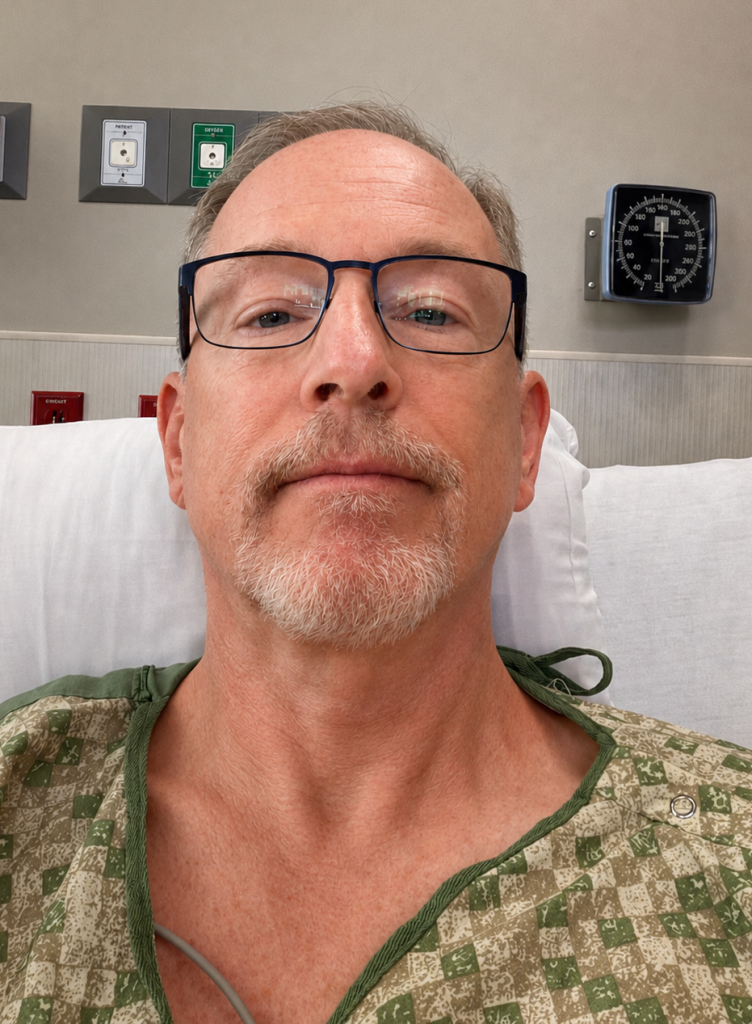


9:30 a.m. – June 30th, 2026
(Every now and then, I plan on giving some real-life episodes and events that I, the author, am going through. Perhaps it will give you some insight into my writing and where it comes from.)
Having a Heart Ablation
I remember someone telling me that, since I was having a heart ablation and would have to spend the night in the hospital, at least I’d get some much-needed rest.
That’s adorable.
My stay at St. David’s has been anything but restful.
Vital Checks
First came the four-hour vital checks. Then came inspections of the puncture wounds in my groin and neck. Then came blood pressure—98/60 at four in the morning. Apparently, that’s a perfectly acceptable number for someone who should have been left alone to enjoy REM sleep instead of starring in an all-night medical revue.
And they didn’t just send one nurse.
No, that would have been efficient.
Four Nurses
Four of them marched into my room. Three Black women nurses and my male night nurse, whom I’d initially assumed was Filipino. Later, I glanced at the whiteboard in my room and saw someone had written the name “Naar.” It was five in the morning, the room was dark, and my brain was functioning somewhere between anesthesia and delusion, so for all I knew, he was Middle Eastern, Arabic, or a figment of my sleep-deprived imagination.
The three Black nurses, meanwhile, were fully aware I had no idea what planet I was on.
One, a wonderfully large woman, was measuring the contents of the urine container they’d thoughtfully provided. Apparently, they wanted to make sure I wasn’t hanging onto the extra fluid they’d pumped into me after cauterizing the ablated areas. She read aloud the number of milliliters I’d consumed during the day and asked if I’d had anything else to drink.
“Just a small Sprite with lunch,” I said, “and half a bowl of the God-awful no-salt chicken noodle soup.”
Hospital Food
Hospital food has apparently declared war on sodium… and flavor.
Meanwhile, another nurse stood at the computer in the corner, typing what seemed like the complete medical history of mankind. Fifteen solid minutes of clicking. I assumed somewhere in there she’d documented that I was still alive.
My night nurse began hooking me up for yet another EKG, attaching what felt like twenty wires across my chest and upper thighs while my hospital gown wrapped itself around everything like an uncooperative octopus.
Another nurse—sweet as could be—kept calling me “sweetheart” while calmly yanking my gown open and exposing me to everyone in the room.
Southern hospitality apparently ends where hospital modesty begins.
REM Sleep
Fortunately, I hadn’t been deep in REM sleep. Had they arrived ten minutes later, I might have been explaining a perfectly normal case of morning wood, aka a “stiffy,” to four complete strangers before sunrise. Some conversations are best left off the medical chart.
The EKG patches weren’t sticking
The sweet nurse finally announced, “Men usually have oily chests. Just put Band-Aids over them.”
Very interestingly, 🧐 She was right. Problem solved.
Thankfully, all the commotion produced good news. My EKG showed a perfect sinus rhythm with a pulse of 60. Still not my normal athlete’s 54, but a vast improvement over the 120 resting heart rate I’d been living with since May 29.
Progress
I’ll take progress, however it’s packaged.
The larger nurse then informed me it was time to be weighed.
I tried gathering enough of my gown to preserve at least a little dignity. She looked at me, rolled her eyes, and silently communicated what every seasoned nurse already knows:
“Honey… I’ve seen everything.“
Ninety-three kilograms.
Two hundred five pounds.
Still carrying six pounds of extra water from the 199 pounds they’d recorded before surgery.
After what felt like a twenty-minute home invasion disguised as patient care, I finally climbed back into bed.
My nurse asked whether I’d like the blinding overhead light turned off.
“Yes… please.”
I’d already resorted to placing a pillow over my face after watching the end of the Netherlands-Morocco soccer match. Earlier, Germany had lost to Paraguay. Then the Dutch lost in a penalty shootout after regulation and overtime.
Apparently, every team I rooted for had entered the hospital with me.
Elusive Sleep
I finally shut off the television around eleven and tried to sleep. The only lights I could find were the flashing runway lights built into the bed.
Safety features, they said.
Really?
In nearly seventy years, I’ve never once fallen out of bed. I wasn’t planning to begin my stunt career now.
Eventually, exhaustion won.
Probably because I’d started coughing from the breathing tube they’d shoved down my throat during surgery. My throat felt like I’d swallowed sandpaper, and I had a splitting headache. Two Tylenol later, I drifted off beneath the glow of what felt like the interrogation lamp from every police movie ever made.
As it turned out, I was lucky.
I managed almost an extra hour of sleep before my dreams were interrupted.
I’d just begun dreaming about some ridiculously handsome male nurse giving me a lap dance—thanks to a friend in Colorado who’d texted earlier asking whether any hot male nurses were taking care of me—when someone knocked on the door.
Suprise
I woke up with a full erection.
Perfect timing.
Fortunately, the woman entering announced she was there only to draw blood.
My excitement immediately surrendered.
She wrapped the tourniquet around my arm tightly enough to qualify as medieval torture, collected what looked like six or eight vials of blood, spent another ten minutes typing into the computer, and finally disappeared.
Peace at last.
For almost two hours.
At seven o’clock, my cardiologist walked in to tell me the surgery had gone well. He’d found the atrial flutter causing all the trouble and then launched into fluent Doctor.
Something about why he hadn’t placed the Watchman device he’d planned to implant. I thought I heard him say “pulmonary intrusion.” Google had absolutely no idea what that meant, although it suggested he probably meant a pulmonary contusion.
That actually made sense.
The area where he wanted to place the Watchman had become too bruised during the ablation, so he’d wait six weeks. He’d already mapped out exactly where the little umbrella-shaped device would go, and from the way he described it, the procedure itself should be relatively quick.
The one question I forgot to ask?
Whether I’d have to spend another night in the hospital.
Because now that I’ve experienced the luxury accommodations at St. David’s…
…I’d really like to know how much sleep I should plan on not getting next time.
Oh… the nurse just informed me I’ll be spending another night here in six weeks for the Watchman procedure. Apparently, this is the sequel. Think Night at the Museum, except the only things that come alive are the monitors, IV pumps, blood-pressure cuffs, and the nurses who appear every time I finally fall asleep 😴
Fun Facts
The WATCHMAN device procedure boasts an implant success rate of 94% to 99%. Most importantly, it is highly effective at reducing stroke risk, offering comparable protection to warfarin. After the device heals (typically 45 days), about 96% of patients are able to successfully discontinue lifelong blood thinners.
Watchman.com
One last thing that several people asked about… During complex procedures like Atrial Fibrillation (AFib) or Ventricular Tachycardia (VT) ablations, anesthesiologists routinely use general anesthesia and intubation. Because cardiac procedures require deep sedation that can suppress breathing, intubation secures your airway and ensures uninterrupted oxygen delivery. Furthermore, having a secure breathing tube in place is a critical preemptive measure that enables your care team to respond immediately in the event of a medical emergency.
Just and FYI
My newest book, Something About Martin, is being released this August—I’m not sure of the exact date yet, but I will keep you posted.
Martin Reily has lost track of how many decades he’s loved Tony—fifty? Sixty? Long enough to march for their rights in 1977, to grieve Harvey Milk together, to build a quiet life by the water in Waikiki. So when Martin finds himself talking to Tony on the lanai, laughing with him over coffee, it takes a moment to remember: Tony’s been gone for almost a year.
Enter Charlie—a broke, kind-hearted college student Martin meets at the grocery store and impulsively invites to rent his guest room. What starts as an unlikely arrangement becomes something neither man expected: a kitchen fire, a startling diagnosis, a 90th birthday no one will forget, and a bond that “bypasses age and bloodlines.”
Something About Martin is a story about the kind of love that outlives memory itself—about chosen family, the dignity of growing old, and the quiet, stubborn grace of showing up for someone, one whistled tune at a time.